
| Pressroom
Building LinkedIn Premium All‑in‑One: Unified AI‑Powered Workflows for Small Businesses

Building a great product, rather than just a good one, can boil down to how early and often users are brought into the development. With a 60% growth of global members on LinkedIn adding “founder” to their profile, it’s evident that the small business community is quickly growing and that it brings along its own needs and opportunities.
In our early engagement with this community, one theme kept coming up in conversations: small business owners needed something simple, that doesn’t require time or expertise to help them sell, market, and hire. They’re also looking for ways to grow their businesses by searching for new clients and make their brands visible in the right places. When their businesses grow, they want to search for the right people to hire and expand their teams.
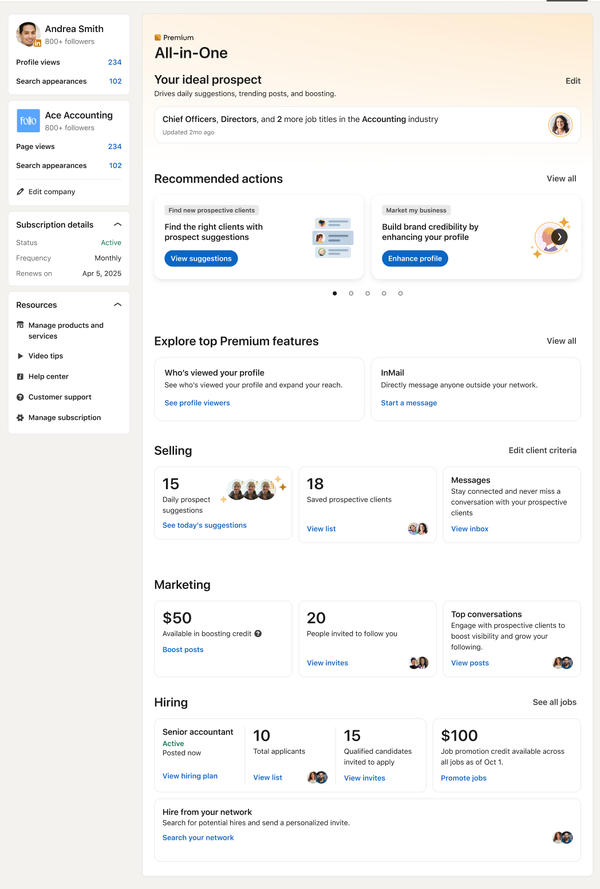
With Premium All‑in‑One, we set out to simplify this experience by bringing together key capabilities across sales, marketing, hiring, and the LinkedIn platform into one cohesive product. While LinkedIn offers powerful tools for each of the needs described, they were historically spread across multiple products, each optimized for different workflows and customer segments.
From an engineering perspective, we needed to unify systems across multiple lines of business while building a consistent product experience from the ground up. At the same time, we optimized for rapid iteration and early user feedback, enabling real customers to start using the product just months into development.
In this post, we’ll walk through how we approached this challenge, from designing a unified architecture to enabling experimentation at speed, and the lessons we learned building a cross‑platform product at production scale.
Product evolution, leveraging LLMs and AI
A core challenge for Premium All-in-One was helping new subscribers see value immediately, even when they had little or no prior activity on LinkedIn. Traditional activity‑based signals work well over time, but they are insufficient during a member’s first sessions.
To address this, we introduced an LLM‑based approach to infer an initial Target Audience using a member’s profile, company information, and the products or services they offer. Rather than generating free‑form outputs, the model selects from existing LinkedIn taxonomy categories, ensuring consistency with downstream systems and reducing the risk of irrelevant or unsafe recommendations.
We evaluated multiple model options and chose an approach that balanced relevance, latency, and operational cost. In practice, this allowed new subscribers to receive meaningful prospect recommendations and content suggestions from their first visit, while still allowing activity‑based signals to take over as engagement increased.
Throughout this process, we applied strict privacy guardrails: model inputs are scoped to individual members, never shared across subscribers, and always respect member preferences.
Target audience definitions
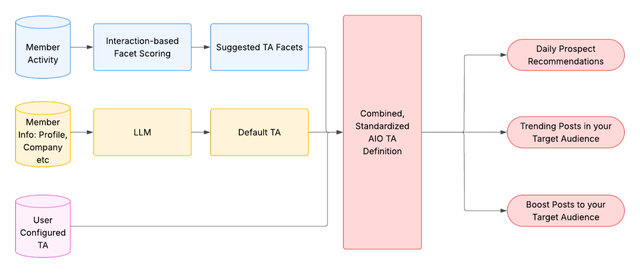
At the core of Premium All-in-One is the Target Audience (TA) definition, which is a graph representation of who a small business leader wants to reach. Existing audience models were optimized for larger customers, so we built a version specifically tuned for small business workflows and scale. Every feature in Premium All-in-One provides differentiated value due to this TA definition, nudging the leader to take timely actions to stand out and connect with this audience. We generate this definition through three complementary approaches, each solving for a different phase of the member lifecycle.
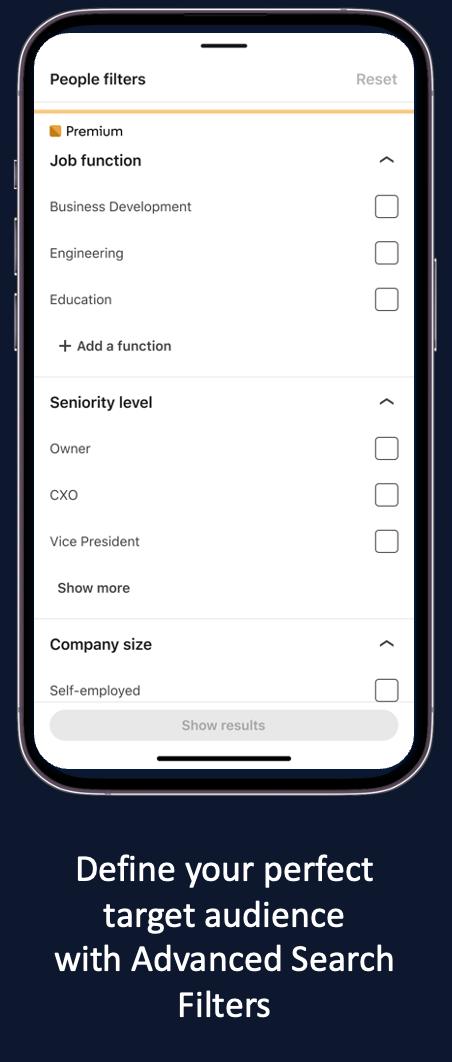
Our goal is to accurately infer and recommend the most relevant Target Audience, acting as an assistant that the small business leader can rely on.
Activity-based TA: We start with activity‑based signals derived from a member’s engagement across LinkedIn, such as profiles viewed, connections made, and messages sent. These signals help us infer who the member is most interested in reaching and they evolve over time as the member’s behavior changes. For example, when a small business leader views a profile, sends a message or InMail, connects with, or saves a prospect, we record weighted signals. Each activity type carries a distinct weight with an exponential time-decay factor applied over a rolling window. A daily pipeline summarizes members’ facets across dimensions such as job title, function, seniority, location, and industry, scoring each facet to select the top-K most relevant categories per dimension. During onboarding, we pre-fill the top five to give members an immediate starting point.
For new subscribers without sufficient activity history, we use an LLM‑based approach to infer an initial Target Audience using information about the company they represent, and the products and services they offer. In addition, factors like the subscriber’s experience and location are also used as signals to generate the most relevant target audience persona including profile and their company. Rather than generating free‑form outputs, the model selects from existing LinkedIn taxonomy categories, ensuring consistency & relevance.
The model receives the member’s profile, company information, and products or services as context, and then selects relevant values from eligible LinkedIn taxonomy categories. All model inputs and outputs are scoped to individual members, respect member preferences, and are never shared or cross‑trained across subscribers.
Implicit TA: Even with activity-based and LLM-based TA, we observed that some of our subscribers were getting fewer prospects than expected on their first visit and could theoretically not have any fresh recommendations by their fifth visit. Implicit TA addresses this niche problem: liquidity decay. Implicit TA fuses two primary signals to expand the TA definition for a small business leader:
- Buyer-side signals (the most common facet values among a company page’s followers)
- Seller-side signals (the most common facets among prospects the member has messaged or connected with post-subscription).
Daily prospect suggestions
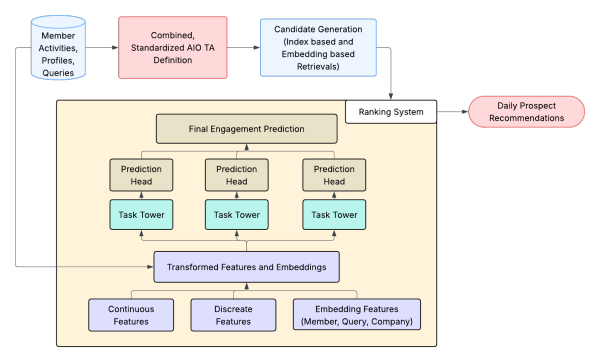
Daily prospect suggestions reduced the effort small business leaders had to spend manually searching and reviewing the profiles of new potential customers by curating a high signal list of 15 prospect suggestions every day. This list of prospects reduces cognitive load and decision fatigue, because it highlights insights on what makes a prospect relevant. Furthermore, the small business leader can save the prospect or reach out directly.
The system customizes recommendations based on a member’s explicit Target Audience preferences, company data (profile, product listings), and behavioral signals from network activity. To ensure a constant supply of new leads, the list refreshes overnight, excluding any prospects the member has already acted upon. Members can easily view profiles, save leads, or message prospects directly from the list. Similar to the Target Audience definition, though this existed as a feature in Sales Navigator, we fine-tuned a solution that aligns better towards a small business leader’s need.
The suggestions are generated using the foundational Target Audience definitions described earlier, funneling through both index-based and embedding-based candidate retrieval techniques. To balance both relevance and freshness, we combined multiple retrieval and ranking approaches to surface a small, high‑signal set of prospects each day. This allowed us to reduce cognitive load for small business leaders while ensuring a steady supply of new, relevant leads.
Posts trending within a target audience
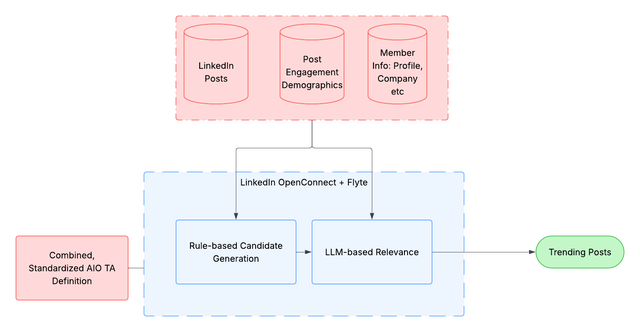
In our customer interviews we learned that small business leaders don’t want to send out cold outreach and want to build up an authentic brand within their TA naturally. So we designed a feature that identifies top posts on LinkedIn which are getting engagement from customers/prospects in their Target Audience, so they can take actions like commenting or resharing with their perspective and start building an authentic, warm presence with their TA.
Trending prospect posts consumes TA from the other direction – not to find people, but to find posts worth engaging with. We built an offline pipeline that identifies recent posts engaging members within a subscriber’s Target Audience, then applies lightweight filtering followed by targeted LLM scoring to surface posts worth engaging with.
We use an instruction‑tuned language model to score candidate posts along relevance dimensions, such as topical fit and credibility for the small business leader to engage. This two-stage approach of cheap rule-based filtering followed by targeted LLM scoring improved content liquidity while keeping inference costs proportional to the filtered candidate set rather than the full post corpus.
Additionally, all of this turns the brand flywheel, when we invite the prospects who engage with their content – posts and comments – to follow the small business leader, enabling them to position themselves as a thought leader in the space.
Post boosting is another feature that utilizes the omnipresent and intelligent Target Audience definition, by giving members a quick way to boost eligible posts to the most critical set of members – their Target Audience.
More AI-powered features
Profile writing assistant is an AI-assisted tool that helps small business leaders enhance their professional and brand image. It leverages an LLM that uses a member’s experience and company information to generate high-quality profile enhancements that establish the member as a thought leader and promote their business. Before launch, we evaluated these suggestions across dimensions such as accuracy, safety, coherence, and tone, balancing personalization with conservative safety thresholds to maintain trust.
Small business leaders have a lot to do to grow their business and are stretched across competing priorities, hence we invested in building a recommendation model that highlights the most relevant calls-to-action from all available tasks. These Recommended Actions feature on the Premium dashboard, where a key action from the Premium All-in-One feature set is recommended to the user based on various aspects of the small business owner’s context. The current system uses a data-driven approach, relying on user-product matching scores, member-to-product proximity scores, and activity signals. A calibration layer is also applied to enforce cool-off periods for completed tasks and adjust the recommendations for new members. This architecture is built in an extensible way, designed to evolve from simple business logic and rules-based systems to more advanced AI models.
Creative Go-to-Market plan
A key aspect of our go-to-market plan was to get the features we were building in the hands of real users as early as possible to learn from their feedback. Four months into development, we enabled Premium All-in-One for a small set of real small business leaders and invited them to hands-on sessions. Early feedback from the members such as Profile Writing Assistant, relevance of Trending Prospect Posts, and value of automatically inviting content engagers to follow the member directly informed product and engineering decisions ahead of a gradual public release. We improved the prompt of Profile customization to better feature their Small Business in their about section, we invested in building an LLM based Trending Posts and added the opt-out flow for invite to follow in the Onboarding flow of the SKU. This approach enabled the team to incorporate the feedback in an agile way, making the product ready for a gradual public release starting August 2025.
Lessons learned
Start with the customer problem, not the organization chart
The challenge behind Premium All-in-One offering wasn’t just building something new. It was bringing together engineers from multiple parts of the organization, as well as different products and systems that had evolved independently into a single solution for Small Business leaders.
As mentioned, we needed to bring capabilities across our various business line - Sales, Marketing and Talent - into one product. This exposed inconsistency across these surfaces such as supported currencies, how the ledger is managed for credits, how revenue is recognized, how access provisioning is managed and how relevance is defined.
To solve this, we started with customer needs and it enabled us to reduce fragmentation across the products and build a single, unified solution. We invested in shared experiences, common entitlement models, consistent onboarding, unified lifecycle management, and reusable AI foundations, and created a more coherent experience for customers.
Focused collaboration enables speed without sacrificing quality
Premium All-in-One brought together teams across multiple lines of business with a shared goal and tight timelines. Focused collaboration enabled speed without sacrificing quality. By aligning early on goals and dependencies, teams across LinkedIn were able to work in parallel while maintaining clear ownership.
Ramp discipline builds trust
Ramp discipline allowed us to move fast without compromising trust. Each rollout phase was gated by explicit quality and reliability criteria, allowing us to address issues early before scaling further.
Reusable foundations compound over time
By investing early in shared AI models, serving infrastructure, and feedback loops, we created a foundation that not only supports Premium All-in-One today but accelerates future Premium experiences.
Conclusion
In a few months of GA, this SKU has already become our largest new subscription. And not only that, our customers are saying that Premium All-in-One has truly enhanced their ability to reach out to the right prospective customers. Our customers are seeing impact in outcomes on their core Jobs-to-be-done across building their networks, visibility and outreach:
- Network:
- +57% increase in monthly followers
- +29% increase in monthly connections
- Visibility:
- +40% increase in profile views
- Outreach:
- +24% messages that get a response back from the receiver
- +61% messages with replies from prospects
Premium All-in-One demonstrated that we can build and scale a unified, AI‑powered Premium experience while upholding member privacy and trust. We are building new capabilities on these foundations to enhance future Premium products on LinkedIn.
Acknowledgements
We would like to thank the many engineers, designers, product managers, and partners across LinkedIn who contributed to Premium All-in-One. Special thanks to our leadership team for support in building this SKU and reviewing the many drafts of this post - Aarthi, Aditya, Aman and Bipin.

