
| Pressroom
LinkedIn Data Finds Women Make Up Just 23% of the C-Suite and 28% of Founders

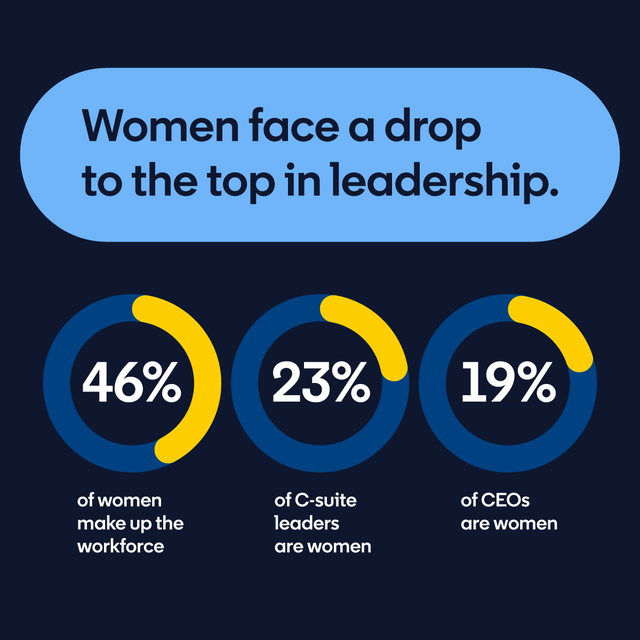
After rising from 26.7% in 2015 to 29.6% in 2023, women's representation in top management has remained unchanged for four consecutive years. Women make up 46% of workers at the entry level, but their representation falls by half to just 23% in the C-suite. At the recent rate of progress, the estimated time needed to reach leadership parity has nearly doubled from 50 years to 90 years.
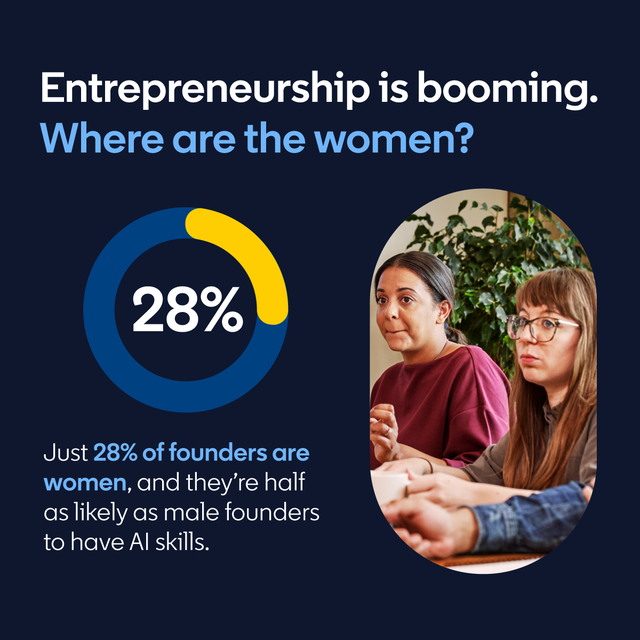
At the same time, entrepreneurship is expanding rapidly as AI lowers the barriers to starting and scaling a business. The number of LinkedIn members adding 'founder' to their profile has more than tripled since July 2022. But women are not gaining ground in that growth: their share of founders has remained at approximately 28% since 2022.
New data from LinkedIn's Economic Graph, published today in the World Economic Forum's Global Gender Gap Report 2026, shows that women's progress has stalled across three major pathways to economic opportunity: founding a company, rising into leadership within an established one, and having the AI skills in order to succeed in both.
Women's Representation Falls by Half on the Path to the C-Suite
Women enter the workforce in nearly equal numbers to men, accounting for 46% of entry-level workers across the economies studied. Their representation declines at every step that follows, falling to 23% at the C-suite level.
- Women's representation in top management increased from 26.7% in 2015 to 29.6% in 2023, but has not increased since.
- At the rate of progress recorded in the five years leading up to 2020, the leadership gap was projected to close within 50 years. Based on progress since then, it could now take approximately 90 years.
- Women hold just 19% of CEO roles, 27% of chief financial officer roles and 24% of chief operating officer roles.
- Women are better represented in leadership roles traditionally associated with people and communications, accounting for 65% of chief people officers, 64% of chief human resources officers and 45% of chief marketing officers.
The differences across industries are also significant. The drop in women's representation between entry-level and C-suite roles is steepest in transportation, construction and technology, where women's representation cuts in half. Consumer services and education have the smallest declines, though women's representation still falls by approximately one-third.
Entrepreneurship Is Growing, but Women's Share Is Not
Entrepreneurship is booming against the backdrop of a sluggish global labor market. The number of people on LinkedIn describing themselves as founders has more than tripled since July 2022. In the United States alone, the share of LinkedIn members adding “founder” to their profiles increased by almost 70% over the past year.
Nearly four in 10 professionals globally say AI has made them more likely to start a business, while more than 60% of small-business leaders say AI makes starting and running a company easier.
Women, however, are not gaining ground in this expansion.
- Women's share of founders rose during the last decade and accelerated ahead of the pandemic but has remained at approximately 28% since 2022.
- In 2025, just 2% of global venture capital went to founding teams made up entirely of women.
- Women hold 31% of top management roles in capital-market activities, including venture capital and private equity, compared with 40% of the sector's broader workforce.
This matters because entrepreneurs and small businesses are major sources of employment and economic growth. Small businesses account for approximately 90% of businesses and 70% of GDP globally. They are also proving more resilient than larger employers when it comes to hiring in several major economies.
In the United States, hiring is 21% below pre-pandemic levels at small businesses, compared with 39% below at the largest enterprises. In the EU and UK, hiring at the smallest firms has increased by 44% in the UK and 13% in the EU since 2019.
If entrepreneurs and small businesses are increasingly responsible for hiring, innovation and growth, economies cannot afford for women to remain less than one-third of the founders building the next generation of companies.
A New AI Skills Gap Is Emerging Among Founders
AI is increasingly becoming a core entrepreneurship skill, helping business owners automate routine work, create content, improve decision-making, recruit talent and gain capabilities that once required larger teams and budgets.
Both women and men founders are gaining AI skills, but men are gaining them faster:
- The share of male founders with AI skills increased from 4.7% in 2019 to 15.2% in 2026.
- The share of women founders with AI skills increased from 2.3% to 9.1% over the same period.
- Although the gender gap in AI skills has remained relatively steady across the broader workforce, it has widened among founders.
The divide extends beyond entrepreneurship. Women accounted for just 26% of U.S. hires into AI roles in 2025, compared with 50% of hires into non-AI occupations. Globally, women hold only 13% of C-suite AI leadership roles at AI companies.
At the same time, women account for 57% of workers in occupations considered most likely to be disrupted by generative AI, compared with 43% for men.
Together, these findings show that women are overrepresented in roles facing disruption while remaining underrepresented in the roles building, applying and leading AI.
Where Leaders Can Act
- Measure for accountability: Understand women's representation in leadership and AI roles across the organization, track where progression slows and establish senior-level accountability for improving outcomes.
- Build bridges through sponsorship: Identify high-performing women and actively support their advancement through introductions, coaching, new responsibilities and access to the networks that influence senior-level appointments.
- Invest in future-ready skills: Expand STEM and AI education and upskilling opportunities for women so they are equipped to participate in the AI economy as workers, leaders and founders. Skills-based hiring can also increase women's representation in candidate pools by 24%.
FAQs
What share of C-suite roles are held by women?
Women hold 23% of C-suite roles across the economies studied, compared with 46% of entry-level roles. Their representation therefore falls by half on the path to the highest levels of leadership.
Is women's representation in leadership still increasing?
Progress has stalled. Women's representation in top management increased from 26.7% in 2015 to 29.6% in 2023 and has remained unchanged since. Based on the recent rate of progress, reaching leadership parity could now take approximately 90 years.
How do career breaks affect women's advancement?
Women are more than four times as likely as men to take full-time parenting breaks and are less likely to advance after returning. Among senior individual contributors, men who take a full-time parenting break are 44% more likely than women to be promoted during their first year back.
How quickly is entrepreneurship growing?
The number of LinkedIn members describing themselves as founders has more than tripled since July 2022. In the United States, the share of members adding “founder” to their profiles increased by almost 70% in the past year.
What share of founders are women?
Women have accounted for approximately 28% of founders since 2022. Their share increased over the previous decade but has since leveled off despite the broader surge in entrepreneurship.
Is there an AI skills gap between women and men founders?
Yes, and it is widening. The share of male founders with AI skills increased from 4.7% in 2019 to 15.2% in 2026, while the share of women founders with AI skills increased from 2.3% to 9.1%.
Why does women's representation among founders matter?
Entrepreneurs and small businesses are increasingly important sources of employment, innovation and economic growth. If women remain underrepresented among founders—particularly founders equipped with AI skills—they risk having less access to the economic value created by new businesses and technologies.
What can employers do to accelerate progress?
LinkedIn's findings point to three areas of action: measuring representation and creating accountability; sponsoring high-performing women for advancement; and investing in STEM, AI and other fast-growing skills. Employers can also normalize non-linear career paths and adopt skills-based hiring practices.
Methodology:
The leadership analysis uses aggregated and anonymized LinkedIn platform data to examine members' employment histories, seniority and career progression across the economies included in the World Economic Forum's Global Gender Gap Report 2026.
The founders analysis examines LinkedIn members who list “founder” as their current job title. AI skills are identified using skills explicitly listed by members on their LinkedIn profiles or inferred from other profile information.
The career-break analysis compares changes in seniority among women and men after they return from full-time parenting breaks. Gender is inferred using first-name information and reported only in aggregate. Members whose gender could not be inferred are excluded from gender-based analyses.

